

Introduction
When your laptop WiFi keeps disconnecting, everything grinds to a halt. Video calls freeze. Downloads fail. Web pages refuse to load. You reconnect, and two minutes later your laptop drops WiFi all over again.
This is one of the most common complaints among laptop users worldwide. Whether your WiFi keeps disconnecting on laptop running Windows 10, Windows 11, or macOS, the frustration is the same. It affects every brand — HP, Dell, Lenovo, ASUS, Acer, Samsung, and MacBook alike.
The good news? Most reasons your laptop keeps losing WiFi connection are easy to fix without calling a technician. This step-by-step guide covers every proven solution, starting from the easiest and moving toward advanced fixes. By the end, you will know exactly how to stop your laptop WiFi from disconnecting for good.

Quick Answer
If your laptop WiFi keeps disconnecting, do these three things first: restart your router and laptop, update your WiFi adapter driver through Device Manager, and disable the power management setting that lets Windows turn off your wireless adapter. These three steps fix WiFi disconnecting on laptop for roughly 80% of users.
Why Your Laptop WiFi Keeps Disconnecting
Before jumping to solutions, understanding why your laptop WiFi keeps dropping helps you pick the right fix faster. Here are the most common causes:
- Outdated or corrupted WiFi drivers — Your wireless adapter needs up-to-date driver software. Old or broken drivers are the number one reason a laptop WiFi connection keeps dropping.
- Power management settings — Windows aggressively turns off the WiFi adapter to save battery, which causes your laptop WiFi to disconnect randomly.
- Router issues — An overloaded, overheating, or outdated router kicks devices off the network without warning.
- Network congestion — Too many devices sharing one WiFi band leads to an unstable connection.
- Weak signal strength — Being too far from the router means your laptop keeps losing WiFi connection due to poor signal.
- Incorrect network configuration — Wrong DNS settings or IP conflicts interrupt your WiFi.
- Software conflicts — VPNs, antivirus programs, or recent Windows updates sometimes cause WiFi to disconnect randomly on laptop.
- Faulty WiFi hardware — In rare cases, a failing internal WiFi card is to blame.
How to Fix Laptop WiFi Keeps Disconnecting (Step-by-Step Methods)
Below are 10 proven methods to fix WiFi disconnecting on laptop. Start with Fix 1 and work your way down.
Fix 1: Restart Your Router and Laptop
This is the fastest way to fix a laptop that keeps dropping WiFi. Restarting clears temporary glitches in both devices.
- Shut down your laptop completely (do not use sleep mode).
- Unplug your router from the power outlet.
- Wait 30 seconds.
- Plug the router back in and wait until all indicator lights stabilize (1–2 minutes).
- Turn on your laptop and reconnect to WiFi.
Why it works: Routers accumulate small software errors after running continuously for days. A power cycle clears them and gives your laptop WiFi a fresh start
Fix 2: Forget and Reconnect to the WiFi Network
A corrupted saved network profile can cause your laptop WiFi to keep disconnecting repeatedly. Removing it forces a clean reconnection.
On Windows 10/11:
- Click the WiFi icon in the taskbar.
- Right-click your WiFi network name.
- Select Forget.
- Click the network again and re-enter your password.
On Mac:
- Go to System Settings > Wi-Fi.
- Click Details next to your network.
- Click Forget This Network.
- Reconnect with your password.
Why it works: Corrupted profiles store outdated security or configuration data. Starting fresh eliminates this common cause of WiFi dropping on laptop.
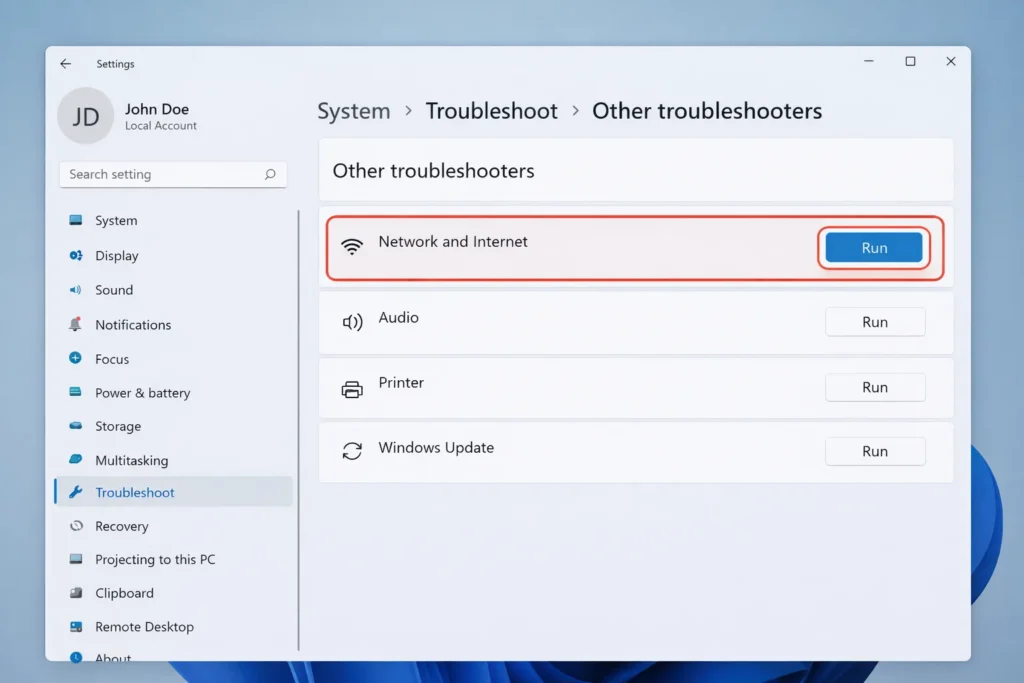
Fix 3: Run the Windows Network Troubleshooter
Windows includes a built-in tool specifically designed to detect and fix WiFi disconnecting issues on laptop automatically.
- Press Windows + I to open Settings.
- Go to System > Troubleshoot > Other troubleshooters.
- Find Network and Internet and click Run.
- Follow the on-screen instructions.
- Restart your laptop after the process completes.
Why it works: The troubleshooter resets broken network components and applies known fixes that stop laptop WiFi from disconnecting.
Fix 4: Disable WiFi Adapter Power Management
This is the single most effective fix when your laptop WiFi keeps disconnecting. Windows allows the system to turn off your wireless adapter to conserve battery, and this directly causes random WiFi drops.
- Press Windows + X and select Device Manager.
- Expand Network adapters.
- Right-click your WiFi adapter (look for names like “Intel Wi-Fi 6 AX201,” “Realtek Wireless,” or “Qualcomm Atheros”).
- Select Properties.
- Click the Power Management tab.
- Uncheck the box labeled “Allow the computer to turn off this device to save power.”
- Click OK.
- Restart your laptop.
Why it works: When this box is checked, Windows shuts down the WiFi adapter during idle moments to save energy. This is the hidden reason most laptops keep losing WiFi connection — especially when on battery power. Disabling it keeps your wireless adapter permanently active.
Fix 5: Update Your WiFi Driver
An outdated wireless adapter driver is a leading cause of laptop WiFi keeps dropping problems on Windows 10 and Windows 11.
- Press Windows + X and select Device Manager.
- Expand Network adapters.
- Right-click your wireless adapter.
- Select Update driver.
- Choose Search automatically for drivers.
- Let Windows install any update it finds.
- Restart your laptop.
If Windows says your driver is up to date: Go to your laptop manufacturer’s support website (HP Support, Dell Support, Lenovo Support, ASUS Support) and search for your exact model. Download and manually install the latest WiFi driver.
Why it works: Driver updates fix known bugs and improve compatibility with modern routers. Many WiFi disconnecting issues on laptop disappear after a simple driver update.
Fix 6: Switch Between 2.4 GHz and 5 GHz WiFi Bands
Most modern routers broadcast two separate WiFi bands. If your laptop WiFi keeps disconnecting on one band, switching to the other often provides a stable connection.
- 2.4 GHz: Longer range, slower speed. More prone to interference.
- 5 GHz: Shorter range, faster speed. Less congestion.
- Click the WiFi icon in your taskbar.
- Look for your network name followed by “5G” or “5GHz.”
- Connect to the alternate band.
- Monitor the connection for 15–30 minutes.
Why it works: The 2.4 GHz band is crowded — microwaves, Bluetooth devices, baby monitors, and neighboring routers all compete on this frequency. Switching to 5 GHz eliminates interference and can fix WiFi dropping on laptop instantly.
Fix 7: Reset TCP/IP and Flush DNS
Over time, your laptop’s network configuration can become corrupted. Resetting it clears errors that cause your laptop WiFi to disconnect randomly.
- Type cmd in the Windows search bar.
- Right-click Command Prompt and select Run as administrator.
- Type these commands one at a time, pressing Enter after each:
textnetsh winsock reset
netsh int ip reset
ipconfig /flushdns
ipconfig /release
ipconfig /renew- Restart your laptop.
Why it works: These commands reset your entire network stack to factory defaults, removing corrupt data that causes your laptop WiFi connection to keep dropping.
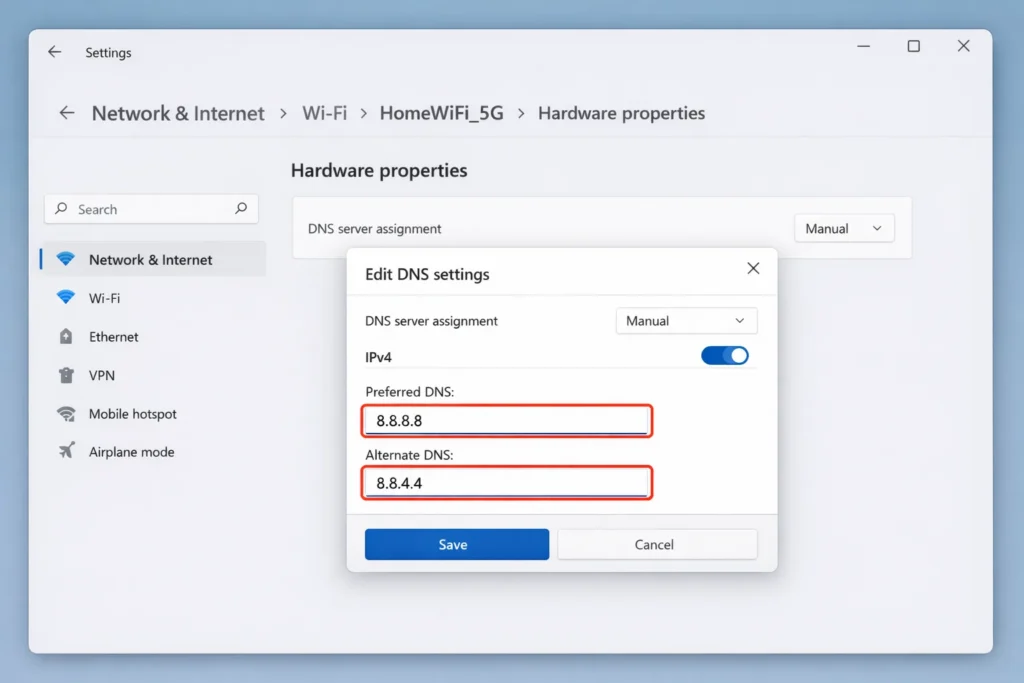
Fix 8: Set Google Public DNS
Your internet provider’s default DNS servers can be unreliable, causing timeout errors that make it seem like your laptop WiFi keeps disconnecting.
- Press Windows + I to open Settings.
- Go to Network & Internet > Wi-Fi > Your network > Hardware properties.
- Click Edit next to DNS server assignment.
- Switch to Manual.
- Enable IPv4.
- Enter these Google DNS addresses:
- Preferred DNS: 8.8.8.8
- Alternate DNS: 8.8.4.4
- Click Save.
Why it works: Google’s public DNS servers are faster and more stable than most ISP defaults. This reduces timeout errors that mimic WiFi disconnecting on laptop.
Fix 9: Ensure WLAN AutoConfig Service Is Running
The WLAN AutoConfig service manages all WiFi connections in Windows. If it stops, your laptop drops WiFi immediately.
- Press Windows + R, type services.msc, and press Enter.
- Scroll down to WLAN AutoConfig.
- Double-click it.
- Set Startup type to Automatic.
- If the Service status says “Stopped,” click Start.
- Click Apply then OK.
Why it works: If this critical service stops running or crashes, your WiFi connection dies instantly. Making sure it is set to Automatic ensures your laptop WiFi stays connected.
Fix 10: Update Your Router Firmware
If your laptop WiFi keeps disconnecting and other devices also experience drops, your router firmware may be outdated.
- Find your router’s IP address (usually 192.168.0.1 or 192.168.1.1 — printed on the router label).
- Type that address into your browser and log in.
- Navigate to Firmware Update, Software Update, or Administration section.
- Download and install any available update.
- Let the router restart completely.
Why it works: Router manufacturers release firmware updates that fix connection stability bugs. Outdated firmware is a hidden cause of WiFi keeps disconnecting on laptop for the entire household.
Troubleshooting Tips
🛠️ Quick Diagnostic Checklist Before You Start Fixing
- Test another device. Connect your phone to the same WiFi. If it also disconnects, the problem is your router — not your laptop.
- Move closer to the router. If your laptop WiFi stops disconnecting when you sit near the router, weak signal is the cause.
- Test on another network. If your laptop stays connected at a café but keeps dropping WiFi at home, your home router or ISP is the issue.
- Temporarily disable VPN and antivirus. Security software sometimes blocks or resets WiFi connections.
- Check for recent Windows updates. If WiFi started disconnecting on your laptop after an update, that update may have installed a faulty driver.
Common Mistakes to Avoid
- ❌ Only restarting the laptop. Always restart the router too. Most users skip this.
- ❌ Trusting “Best driver already installed.” Windows Device Manager does not always find the newest driver. Visit your laptop manufacturer’s website for the latest version.
- ❌ Leaving power saving on. Battery-saving features are the single biggest hidden cause of a laptop that keeps losing WiFi. Always check and disable the power management checkbox.
- ❌ Hiding the router. Placing your router inside a cabinet, behind a TV, or in a closet dramatically weakens the WiFi signal.
- ❌ Overloading the router. Budget routers struggle with more than 10–15 connected devices. Disconnect devices you are not using.
- ❌ Ignoring router firmware. Many people never update their router. Check at least once every three months.
Additional Tips to Prevent WiFi Disconnecting on Laptop
Follow these habits to stop your laptop WiFi from disconnecting in the future:
- Restart your router weekly. A once-a-week reboot prevents memory buildup and keeps connections stable.
- Position your router centrally. Place it in the center of your home, elevated on a shelf, away from walls and metal objects.
- Invest in a mesh WiFi system. If you live in a large home, a single router cannot cover every room. Mesh systems from Google Nest, TP-Link Deco, or Netgear Orbi provide whole-home coverage and prevent your laptop WiFi from dropping.
- Keep Windows and macOS updated. Operating system updates often include WiFi stability patches.
- Use the High Performance power plan. Go to Control Panel > Power Options and select High Performance. This prevents Windows from aggressively turning off hardware — including your WiFi adapter — to save power.
- Replace your router every 3–5 years. Older routers lack support for modern WiFi standards and security protocols.
Frequently Asked Questions
Why does my laptop WiFi keep disconnecting every few minutes?
When your laptop WiFi keeps disconnecting every few minutes, the most likely cause is the Windows power management setting that turns off the WiFi adapter. Open Device Manager, find your wireless adapter, go to Properties > Power Management, and uncheck “Allow the computer to turn off this device to save power.” Outdated WiFi drivers are the second most common cause.
Why does my laptop keep losing WiFi but other devices stay connected?
If only your laptop drops WiFi while phones and tablets remain connected, the problem is specific to your laptop. Update your WiFi driver, disable power management for the adapter, and run the Windows Network Troubleshooter. A laptop-specific issue usually traces back to drivers or power settings.
Why does my laptop WiFi disconnect after sleep mode?
Windows turns off the WiFi adapter during sleep to save battery. When the laptop wakes up, the adapter sometimes fails to reconnect. To fix WiFi disconnecting on laptop after sleep, disable the power saving option in Device Manager (Fix 4) and set your power plan to High Performance.
How do I know if my laptop WiFi card is broken?
If you have tried every fix in this guide and your laptop WiFi keeps disconnecting, your internal WiFi card may be faulty. Buy an inexpensive external USB WiFi adapter (under $15 on Amazon). If the external adapter works without disconnections, your built-in WiFi hardware needs to be replaced.
Can a Windows Update cause my laptop WiFi to keep dropping?
Yes. Certain Windows updates have been known to install incompatible WiFi drivers or change network settings that cause WiFi to disconnect randomly on laptop. If the problem started after an update, go to Device Manager, right-click your WiFi adapter, select Properties > Driver > Roll Back Driver. You can also uninstall the recent update through Settings > Windows Update > Update History > Uninstall Updates.
Conclusion
When your laptop WiFi keeps disconnecting, do not panic. The fix is almost always one of the solutions listed above. Start with the basics: restart your router and laptop, forget and reconnect to the network, and run the Windows troubleshooter. If the problem persists, disable the WiFi adapter power management setting and update your wireless driver. These five steps alone fix WiFi disconnecting on laptop for the vast majority of users.
For stubborn cases, reset your network settings using Command Prompt, switch to Google DNS, or update your router firmware. And if nothing works, an inexpensive USB WiFi adapter will confirm whether your internal hardware needs replacing.
Bookmark this guide. The next time your laptop WiFi keeps dropping, you will know exactly what to do.
- Microsoft — Fix Wi-Fi Connection Issues in Windows
- Google Public DNS Documentation
- Apple — If Your Mac Doesn’t Connect to WiFi




[…] Laptop WiFi Keeps Disconnecting Fix: 10 Proven Solutions (2026) […]